
Motoro Stingray for Sale
The Motoro Stingray, often called Potamotrygon motoro in scientific texts, is central to freshwater ray keeping. Aquarists who transition into stingray husbandry often receive this recommendation, but they should perhaps approach it with nuance. Its perceived ease of access does not remove the need for technical skill. This is especially true given the ecological needs and complex behaviour of river ray species.
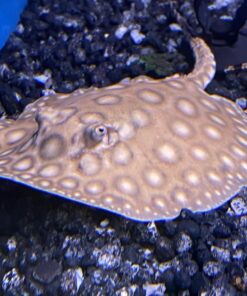
Visually, the Motoro Stingray presents a distinctive array of orange to yellow ocellated patterns set against a darker base. However, it would be misleading to assume uniformity across specimens. Pattern expression may vary significantly depending on geographic origin and lineage, raising questions that intersect with ongoing discussions about regional variants and classification boundaries.
Some aquarists prefer “classic” patterns, while others like rarer morphologies. This suggests that the hobby’s social norms partly shape beauty.
Ecological Background and Interpretive Frameworks
Native to South American rivers, the Motoro Stingray has adapted to many environments. It lives in slow tributaries and dynamic floodplain habitats. People often cite this ecological flexibility as evidence of its resilience.
Yet, scholars and experienced keepers alike have cautioned against overstating such adaptability, noting that captive environments inevitably impose constraints that differ from natural ecosystems. Consequently, the translation of wild conditions into aquarium settings remains an area of active interpretation rather than settled consensus.
For those exploring comparative species or seeking to contextualise the Motoro within a broader collection, our
provides a structured overview of related rays, each with distinct care considerations and visual characteristics.
Care Requirements and Husbandry Considerations
Effective care of the Motoro Stingray needs stable water conditions. Keep the temperature steady and nitrogen waste low. Although stories sometimes say the species handles small changes well, studies show steady conditions prevent stress.
People often overlook substrate selection, but it still matters. People generally prefer fine sand. It helps reduce the risk of abrasion to the ray’s sensitive underside.
Feeding practices further complicate the picture. A diet with high-quality, protein-rich foods may support growth and vitality. The right balance can vary by age, size, and metabolism. External references such as
offer research-informed perspectives that complement experiential knowledge within the aquarist community.
Position Within the Advanced Aquarium Trade
In both commercial and enthusiast settings, people often see the Motoro Stingray as a starting point. It is also a focus of ongoing improvement.
This dual status reflects a broader tension within ornamental aquaculture, where accessibility and expertise are not mutually exclusive but rather dynamically related. Ownership may start with liking how something looks. It often grows into deeper questions about care, ethics, and nature.
Aquarists interested in constructing a balanced and visually cohesive aquarium may also consider integrating species such as
which are often discussed in relation to stingrays due to their complementary spatial use and shared environmental requirements.
Motoro Stingray